
Cabinet Decision No. 209 of 2025 establishes a unified legal framework for the exchange of tax information upon request (EOIR) in the UAE. The decision consolidates existing rules, clarifies regulatory responsibilities, and formalises procedures for responding to requests from foreign tax authority requests.
This development reinforces the UAE’s alignment with international tax transparency standards and strengthens cooperation with global tax authorities. Companies operating in the UAE should assess governance and documentation frameworks to manage compliance risk and prepare for increased regulatory scrutiny.
This article outlines the key updates businesses need to understand to ensure readiness under the new EOIR framework.
Expanded Record-Keeping Requirements
Cabinet Decision No. 209 establishes a clear legal basis for maintaining information that may be required for tax-information exchange, including:
- Ownership and identity information
- Banking and financial account details
- Accounting records and financial statements
- Information on legal entities and legal arrangements
These requirements apply to companies, trusts, and other legal arrangements operating in the UAE. Organisations with complex group structures, free zone entities, or cross-border arrangements should review their document retention frameworks to ensure information can be retrieved promptly and accurately.
Structured Compliance Framework and Administrative Measures
The decision introduces a structured compliance framework, supported by proportionate administrative measures. It also establishes formal grievance and review procedures related to tax-information exchange.
Businesses should:
- Implement documented governance procedures for responding to regulatory requests
- Maintain audit trails demonstrating compliance actions
This approach reduces the risk of administrative penalties and supports efficient engagement with regulators.
Standardised Processes for Responding to Foreign Tax Authority Requests
Cabinet Decision No. 209 promotes a consistent approach across UAE authorities for handling EOIR requests and clarifies coordination with the Ministry of Finance.
Businesses are advised to establish internal protocols to:
- Coordinate between finance, legal, and compliance teams
- Define escalation paths and responsibilities
- Ensure timely submission of requested documentation
Formalised processes improve regulatory certainty but require careful internal alignment and planning.
Enhanced Transparency for Corporate Structures
Companies must maintain accurate records of beneficial ownership, governance documentation, and corporate filings.
This is particularly relevant for:
- Multinational groups
- Free zone entities
- Holding and special-purpose structures
Aligning internal records with regulatory filings reduces the risk of follow-up inquiries and ensures defensible reporting in cross-border tax exchanges.
Alignment Across Free Zones, Mainland, and Regulatory Authorities
The decision clarifies the roles of federal authorities, free zone regulators, and other government entities in providing information to the Ministry of Finance.
Businesses operating across multiple jurisdictions should standardise compliance and documentation practices to ensure consistent and timely responses to EOIR requests.
Reduced Legal Ambiguity and Greater Regulatory Certainty
By consolidating previously fragmented rules into a single legislative framework, Cabinet Decision No. 209 provides:
- Clearer expectations for businesses and regulators
- Consistent interpretation of obligations
- Optimised internal compliance processes for corporate groups
This enhances predictability and supports structured governance and documentation practices.
Increased Cross-Border Tax Scrutiny
The UAE’s commitment to the OECD Exchange of Information on Request (EOIR) standard and international tax cooperation agreements means that information held in the UAE may be shared with foreign tax authorities when legally required.
Multinational groups should ensure that:
- Tax positions are consistent across jurisdictions
- Documentation supports all cross-border arrangements
- Internal policies mitigate inquiry and audit risks
Practical Steps for Businesses
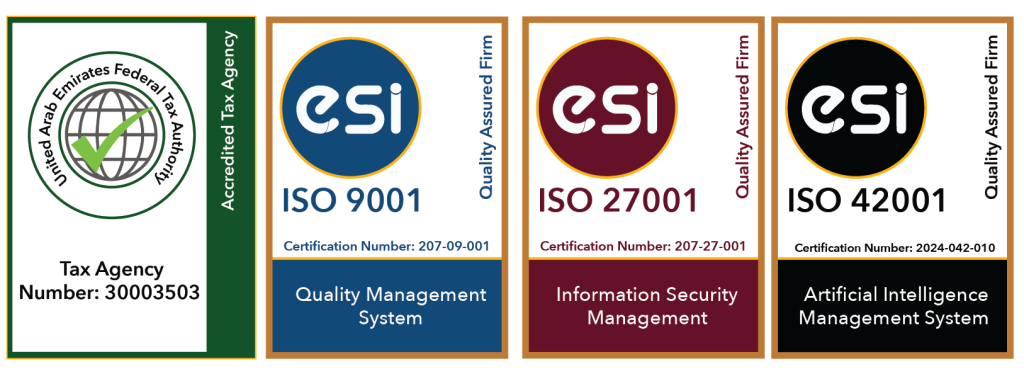
Proactive preparation helps businesses manage risk and remain compliant. As an FTA-approved Tax Agency with ISO 9001, ISO 27001, and ISO 42001 certifications, SimplySolved can provide assistance to assure full compliance including::
- Review and update of corporate records and beneficial ownership registers for accuracy and consistency
- Strengthen document retention systems for accounting, banking, and identity information
- Establish internal EOIR protocols, including roles, escalation paths, and response timelines
- Train finance, legal, and compliance teams on information exchange obligations and regulatory procedures
- Assess group structures and governance frameworks to ensure transparency and defensible tax positions
Implementing these steps early positions businesses to manage compliance risk effectively while ensuring optimised engagement with UAE regulators and foreign tax authorities.
Conclusion
Cabinet Decision No. 209 of 2025 strengthens the UAE’s tax transparency framework and formalises the management of EOIR requests. By clarifying obligations around record-keeping, governance transparency, and regulatory coordination, the decision reduces uncertainty and provides greater predictability for businesses.
Organisations that proactively update documentation practices, internal response procedures, and governance records will be better positioned to manage regulatory risk, maintain compliance, and respond efficiently to cross-border tax scrutiny. Early preparation ensures operational efficiency and strengthens confidence in interactions with regulators as global tax transparency requirements evolve.
About SimplySolved
As an FTA Approved Tax Agency and an ISO 9001, ISO 27001, and ISO 42001 certified provider, SimplySolved supports businesses in managing UAE tax transparency and compliance obligations, including Exchange of Information on Request (EOIR) requirements. approved Tax Agency and an ISO 9001, ISO 27001, and ISO 42001 certified provider, SimplySolved supports businesses in managing UAE tax transparency and compliance obligations, including Exchange of Information on Request (EOIR) requirements.
Our approach combines practical interpretation of tax legislation with structured governance and documentation processes, enabling organisations to respond efficiently to regulatory and cross border tax information requests. By applying best practices and proactive measures, SimplySolved helps clients maintain compliance while aligning with evolving UAE and international tax standards.border tax information requests.
This summary is intended as a general guide and should not be relied upon as binding or specific advice regarding your tax obligations. We strongly recommend seeking professional legal and tax guidance tailored to your individual circumstances.